Which ISO Certification Do I Need for My Business in Qatar?
If you have been told your business needs ISO certification in Qatar but are not sure which standard applies to you, you are not alone. With over a dozen ISO standards in active use across Qatari industries, choosing the right one is the first and most important step before starting the certification process.
This guide breaks down the most commonly required ISO standards in Qatar, which businesses need them, and what each certification covers, so you can make a clear, informed decision before applying.
What Is ISO Certification and Why Does It Matter in Qatar?
ISO Certification is independent, third-party verification that your company’s management system meets internationally recognized standards. It is awarded by an accredited certification body after a formal audit of your processes.
For businesses operating in Qatar, ISO in Qatar has moved from a quality differentiator to a practical requirement. Government tenders through platforms like QGOS, large private-sector contracts, and supply-chain approvals across construction, energy, food, and services now regularly list ISO certification as a pre-qualification condition not an optional add-on.
The question is no longer whether you need it. The question is which one.
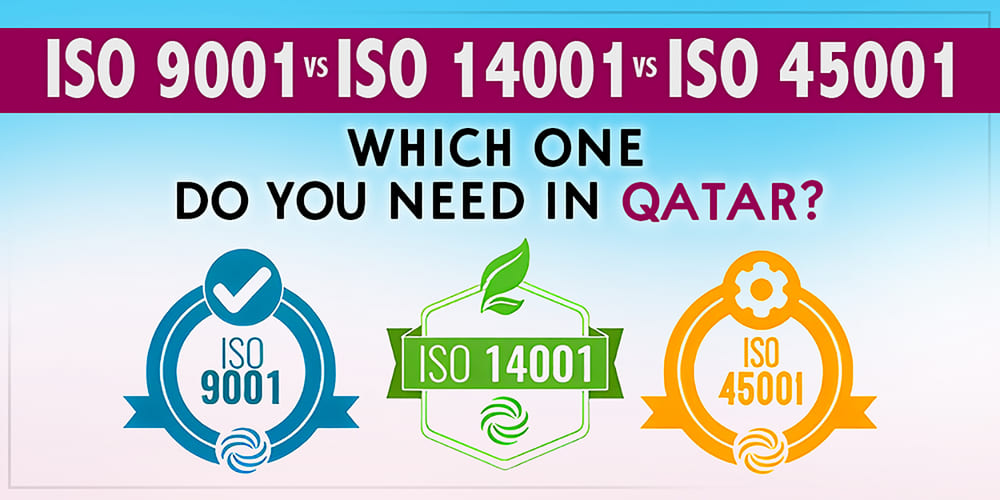
The Most Common ISO Standards Required in Qatar
ISO 9001 - Quality Management System
Who needs it:
- Construction and contracting companies
- Manufacturing businesses
- Professional services firms
- Any business supplying government entities or large private-sector clients
If you are unsure where to start, ISO 9001 is almost always the right first step. Most other standards build on its principles, and many tender requirements list ISO 9001 as a baseline.
ISO 14001 - Environmental Management System
ISO 9001 is the most widely recognized and requested ISO standard across every sector in Qatar. It applies to any business that wants to demonstrate consistent quality in its products or services, regardless of industry.
Who needs it:
- Construction and infrastructure companies
- Oil, gas, and energy businesses
- Manufacturing and industrial operations
- Any business supplying government entities or large private-sector clients
Environmental compliance is increasingly tied to major project approvals in Qatar, particularly for businesses involved in infrastructure or development. If your operations have a direct environmental footprint, ISO 14001 is likely to be required sooner rather than later.
ISO 45001 - Occupational Health and Safety Management System
Who needs it:
- Construction, contracting, and engineering companies
- Oil and gas operations
- Manufacturing and industrial facilities
- Any business with a high-risk working environment or large on-site workforce
ISO 45001 is one of the most frequently required standards for businesses operating on large project sites in Qatar. It is also commonly required alongside ISO 14001 for companies in the energy and infrastructure sectors.
ISO 22000 - Food Safety Management System
ISO 22000 applies specifically to businesses involved in the food supply chain — from production and processing to storage, distribution, and service.
ISO certification for food safety is increasingly required by major retailers, hotel chains, and food-service operators in Qatar, as well as by regulatory bodies overseeing food imports and production.
Who needs it:
- Food manufacturers and processors
- Restaurants and catering companies
- Food importers and distributors
- Hotels and hospitality businesses with food service operations
- Cold-chain and logistics companies handling food products
ISO 27001 - Information Security Management System
Who needs it:
- IT companies and software providers
- Financial services businesses
- Healthcare organizations handling patient data
- Any business managing sensitive client or operational data
With Qatar’s growing digital economy and increasing regulatory focus on data protection, ISO 27001 is becoming a standard requirement for technology and professional services firms working with government or large enterprise clients.
Can a Business Hold More Than One ISO Certification?
Yes, and many businesses in Qatar do. Holding multiple certifications is common, particularly in construction and energy, where clients and project owners may require ISO 9001, ISO 14001, and ISO 45001 simultaneously.
When certifying to more than one standard, these can often be audited together as an integrated management system, which reduces the total time and disruption involved compared to separate audits for each standard.
Which ISO Standard Should You Start With?
A practical way to decide:
Check what your clients or tenders require first. If a specific tender or client contract lists ISO 9001, that is your answer. If it lists ISO 45001 and ISO 14001 together, start with both.
If there is no specific standard is required, ISO 9001 is the right starting point for most businesses. It builds the management system foundation that other standards expand on.
If you are in food production or service, ISO 22000 is non-negotiable and should be your first certification.
If your work is data-heavy or technology-focused, ISO 27001 should be prioritized alongside or instead of ISO 9001.
Frequently Asked Questions
Which ISO certification is most commonly required in Qatar?
Do I need ISO certification to bid on government tenders in Qatar?
Can I get certified to more than one ISO standard at the same time?
Yes. Multiple standards can often be audited together as an integrated management system, which is more efficient than separate audits for each one.
Who issues the ISO certificate in Qatar?
ISO certificates are issued by accredited certification bodies, not by ISO itself. QAC Qatar, operating in partnership with SIS Certifications (accredited by IAS-IAF and IOAS), issues internationally recognized certificates directly to businesses in Qatar.